

Dr Alejandra Urioste is a research fellow, biochemist, and pharmacist from the University of Buenos Aires, Argentina. Alejandra, a keen Immunopaedia Ambassador, loves to share her experience and champion research and teaching around transplant immunology.
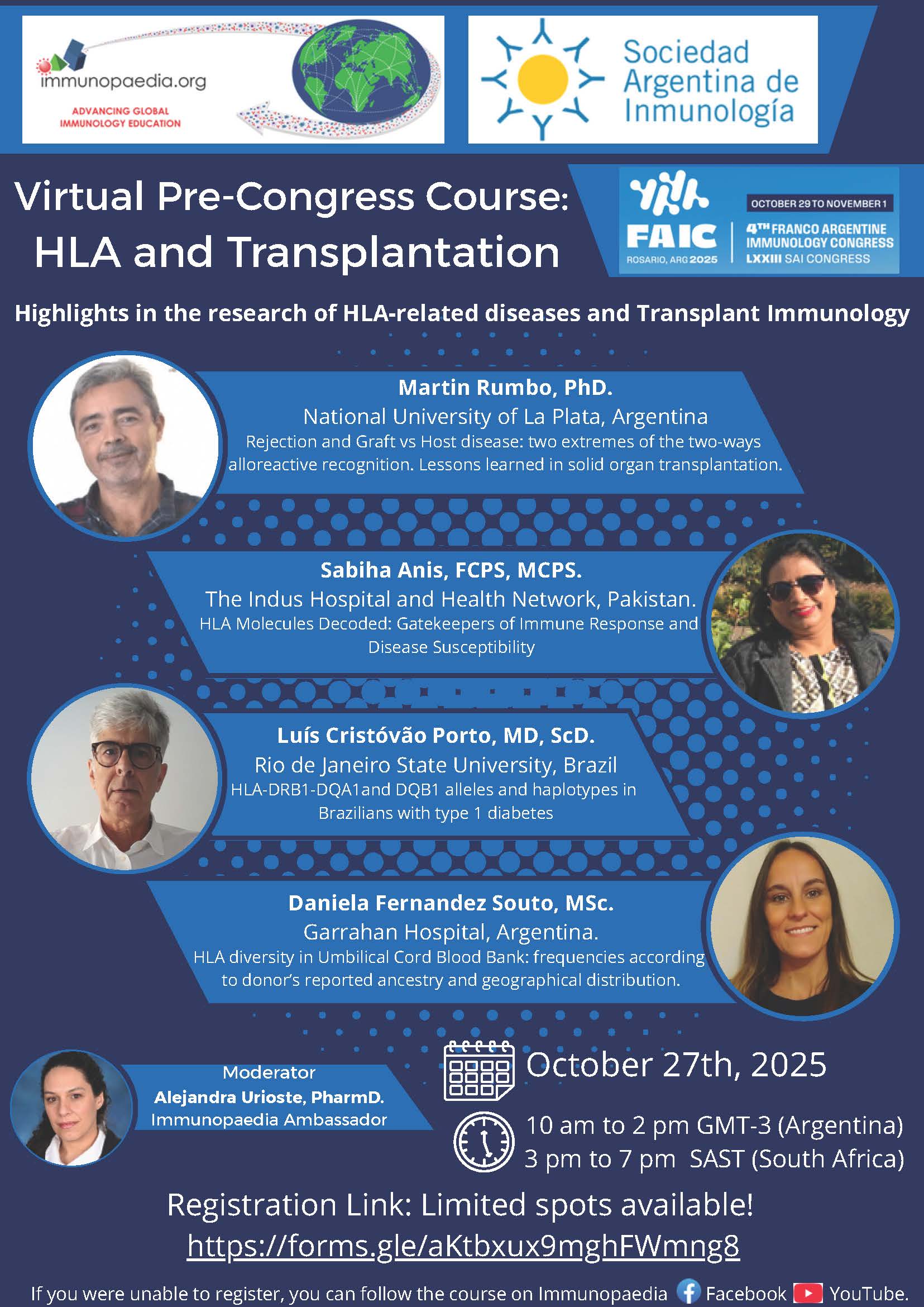
Alejandra organised and ran a Virtual Pre-Congress Course in HLA and Transplantation, which took place online on Monday, October 27th, 2025, as a Pre-Congress Course within the framework of the 4th Franco-Argentinian Immunology Congress (FAIC 2025), held in Rosario, Argentina, from Wednesday, October 29th to Saturday, November 1st, 2025.
Immunopaedia and the Argentinian Society of Immunology (SAI) supported Alejandra in organising the course. Alejandra also gave an excellent presentation on the opportunities that Immunopaedia offers at FAIC 2025, with a guest appearance by Immunopaedia Ambassador Dr Macarena Mamberto!
A short summary by Alejandra of the course and presentation:
We had the participation of four experts in the transplant field at the Virtual Pre-Congress Course in HLA and Transplantation. Bon introduced to me Dr. Sabiha Anis, who was among the first to be contacted and promptly confirmed her participation. I reached out to the remaining speakers, either through previous professional connections or by identifying their work online. Not all of the invited experts were able to respond or participate on this occasion.
Martin Rumbo, PhD. National University of La Plata, Argentina. Dr. Rumbo introduced the concept of alloimmune response and showed results from his project about multi-organ transplantation (intestional transplantation) in an animal model (rat).
Sabiha Anis, FCPS, MCPS. The Indus Hospital and Health Network, Pakistan. Dr Anis spoke about the fact that Human Leukocyte Antigen (HLA) molecules are the most polymorphic elements of the human genome and form the foundation of adaptive immunity.
Luís Cristóvão Porto, MD, ScD. Rio de Janeiro State University, Brazil. Dr Porto presented his research into CHLA-DRB1-DQA1and DQB1 alleles and haplotypes in Brazilians with type 1 diabetes.
Daniela Fernandez Souto, MSc. Garrahan Hospital, Argentina. Dr Souto spoke about Umbilical cord blood (UCB) as a valuable source of hematopoietic stem cells, where donor–recipient HLA compatibility is critical for transplantation success. In Argentina, a country shaped by extensive genetic admixture, the representation of diverse ancestries in public UCB banks is essential but remains poorly characterized.
This was a highly successful meeting, especially considering it was the first event organized in collaboration between Immunopaedia and the Argentinian Society of Immunology (SAI). With 55% of registered participants attending, and a majority of them not affiliated with either institution (72.7% were not SAI members and 54.5% were not Immunopaedia Ambassadors), the event represented an outstanding opportunity to expand the reach and visibility of both organizations. Future collaborative events between Immunopaedia and SAI—covering areas such as immunology education, infectious diseases and vaccination, reproductive immunology, and other related fields—should be encouraged to further strengthen this partnership and its impact.
FAIC 2025 Presentation Report
The presentation took place at noon on Friday, October 31st, 2025. During the session, I presented on Clinical Cases, Courses (including slides with statistical data from the HLA and Transplantation course), and the Ambassadors Program. From previous Immunopaedia meetings and through the website, I had heard about a colleague from Argentina, Dr. Macarena Mamberto, based in Rosario. As she is a researcher at the university where the congress was held, I invited her to share her experience as an Immunopaedia Ambassador. I also presented my own experience, but considered it valuable for the audience to hear the perspective of a local researcher from the same institution.

The audience consisted of approximately 20 young researchers, who appeared particularly interested in learning about the application process for Immunopaedia courses, the sharing of clinical cases, and the use of Immunopaedia materials for educational purposes. I would like to highlight a comment made by one participant at the conclusion of the presentation: she was a student from another university who works as a teaching assistant in Immunology. After learning about Immunopaedia, she expressed her intention to incorporate Immunopaedia resources into her teaching activities.
This event represented an excellent opportunity to promote Immunopaedia in Argentina. The Argentinian Society of Immunology (SAI) expressed significant interest in continuing collaboration, and it may be worthwhile to consider organizing an additional activity during next year’s SAI meeting.
Personally, this experience was highly rewarding, as several researchers mentioned that they had been following my work with Immunopaedia since the HLA and Transplantation course. They attended the session for that reason and indicated that they plan to share Immunopaedia opportunities with their PhD.
Thank you, Alejandra for your excellent organisation and promotion of Immunopaedia! You are an exemplary Ambassador. We hope to continue the collaborations in 2026.
