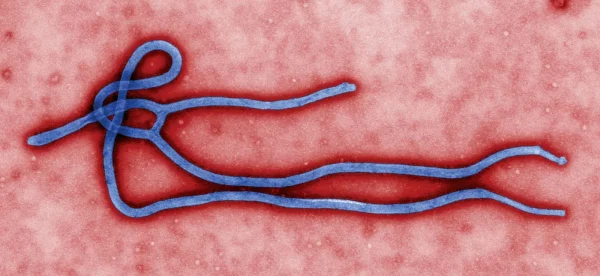
The patient presented with signs and symptoms typical of haemorrhagic fever disease. The initial assessment of the patient raised concerns about Ebola haemorrhagic fever (EHF). This hinges on two main factors: epidemiological risk (he has been to an Ebola endemic area recently) and the presence of clinical signs such as high-grade fever (> 38.0 °C), fatigue, conjunctival injection, and haemorrhagic manifestations (petechiae, ecchymoses). Moreover, laboratory analysis of CBC showed leukopenia and thrombocytopenia which are common signs associated with EHF. Viral RNA amplification from the patient’s blood via RT PCR assay showed positive for Ebola virus. The most likely source of infection would be close contact with a deceased relative who had similar symptoms.
Ebola virus disease (EVD) also called Ebola haemorrhagic fever (EHF), is a zoonotic viral disease affecting both humans and other primates. The virus has been reported to have caused multiple outbreaks in West and Central Africa with case fatality rates often approaching 90 percent. It is transmitted via direct contact with bodily fluids, such as the blood of an infected person or animal, or by coming into touch with objects that have recently encountered contaminated bodily fluids. This emphasizes the precautions to take to prevent any potential transmission or contamination when a case is suspected.
EHF: clinical spectrum
Symptoms of Ebola usually appear 8–10 days after contact, with fever striking suddenly in most cases. The most typical symptoms are chills, myalgia, weariness, and raised body temperature, often known as subjective fever (typically greater than 38.0 °C).
Usually, gastrointestinal symptoms like nausea, vomiting, and diarrhoea start to show up a few days following these initial signs. There could be fluid loss of up to 5–10 L/day during this period, which can range from mild to severe. Conjunctival injection, hiccups, cough and dyspnoea, and localized pain (in the chest, belly, muscles, or joints) are some of the less common symptoms and indicators. While some patients will begin to recover at this point (sometimes following a quite mild illness), a systemic inflammatory response and hypovolemia may cause others to fall into shock. It is common for patients to appear at this time with haemorrhagic episodes, such as petechiae, gastrointestinal bleeding, mucosal haemorrhage, ecchymosis, or persistent seeping from the venepuncture site, as is the case for this patient. The patient’s haemorrhaging often happens when the virus infects the liver, impairing the body’s production of blood clot proteins and leading to blood vessel leakage.
Host immune response to EHF
Once within the host, EBOV subverts the host immune system by suppressing dendritic cell (DC) activity, antagonistic interactions with interferons, and lymphocyte depletion, including natural killer (NK) cells. The most significant early and preferred target cells by EBOV infection have been demonstrated to be monocytes, macrophages, and DCs. By focusing on these immune cells, the virus can worsen the immune response by preventing and limiting their ability to function, which also helps the infection to spread.
DCs are among the most potent antigen-presenting cells and secrete vital interleukins and cytokines that bridge the gap between innate and adaptive immune responses to a variety of pathogens. However, the vital functions of DCs infected with the Ebola virus are severely compromised. These cells are unable to develop into mature or activated cells that can stimulate T cells by upregulating major histocompatibility complex (MHC) molecules. Furthermore, the virus does not enter lymphocytes but can show interaction with CD4+ T-cells. Despite non-entry into lymphocytes, bystander lymphocyte apoptosis is observed during infection which leads to T-cell exhaustion.
Unlike DC infection, monocyte/macrophage infection causes activation and massive cytokine production, known as the “cytokine storm,” which may also contribute to a deadly outcome. High levels of pro-inflammatory cytokines are secreted by infected macrophages, which in turn stimulate the expression of cytokines and chemokines by both infected and noninfected macrophages. This promotes a pro-coagulant state and fluid leakage into the interstitium, resulting in hypovolemic shock and the development of disseminated intravascular coagulation (DIC).
Hypovolemic shock and multiorgan failure usually result in death 6–16 days after symptoms first appear. Effective viral clearance and survival are linked to an early antibody response, mild and measurable anti-inflammatory responses during the early stages of symptoms, and the growth of a strong T cell response.
Fig 2: EBOV infection induces innate immune cell dysfunction. (a) EBOV infection is able to impair type-I IFNs production by infected cells and to block IFN response in uninfected cells; (b) EBOV infection is able to induce massive cytokines/chemokines production by monocytes/macrophages; (c) EBOV infection is able to impair DC maturation and to deregulate cytokine production. (d) EBOV infection is able to induce massive NK apoptosis, thus avoiding NK function and impairing NK-mediated DC maturation help (Goeijenbier et al., 2014)
Fig 3: EBOV infection induces adaptive immune cell dysfunctions. (a) Antibodies production represents the best correlate of protection during EBOV infection. Two different forms of EBOV GP, soluble GP (sGP) and glycosylated-GP (GlycGP), are able to drive antibodies shielding and misdirection. (b) EBOV infection of DC results in a deregulated DC/T synapse, characterized by an effective MHC-peptide/TCR interaction (signal 1), in a high inflammatory microenvironment (deregulated signal 3) in the absence of co-stimulatory accessories molecules on DC surface (ineffective signal 2). The inappropriate DC/T-cell interaction induces T-cell apoptosis, avoids CD4 T-cell clonal expansion, thus blocking all CD4 T-cell helper functions such as CD8-mediated cytotoxicity and antibodies-production by B cells (Goeijenbier et al., 2014).
Pathologic events leading to fatal outcomes.
EVD is associated with several abnormalities that can be considered as possible predictors of fatal outcomes. These can be grouped into those related to haematology, clinical chemistry, and coagulation.
Haematological abnormalities include early leukopenia (as low as 1000 cells per µL) with lymphopenia and subsequent neutrophilia, left shift with atypical lymphocytes, while clinical chemistry abnormalities include elevated liver enzymes (ALT, AST, ALP, and/or GGT), decreased serum albumin, and increased serum creatinine and blood urea nitrogen (BUN). Coagulation abnormalities, which are thought to initiate the progression of disseminated intravascular coagulation (DIC), include early elevation of fibrinogen levels followed by thrombocytopenia (50000–100000 cells per µL), as well as prolonged clotting times.
The time course between the appearance of primary signs and symptoms and the severe manifestation of the disease is relatively low in fatal cases (usually around 8 days). This explains why the patient succumbs to the disease within a week.
Fig 4: Gantt chart depicting clinical and haematological progression of EHF beginning at symptom onset (day 0). Clinical signs and symptoms were derived primarily from human data available after the most recent outbreak in West Africa. Haematology data were derived primarily from NHP data, as available. Human data were complicated due to treatment regimens; however, an attempt was made to correlate recent human data obtained in the West African outbreak with available NHP data (Vine et al., 2017.)
Thrombocytopenia in critically ill patients (TCIP)
Thrombocytopenia is a constant feature of EHF. It’s a condition in which a person has a low number of platelets, the blood cells responsible for clotting. To stop wounds from bleeding, platelets aid in the formation of clots or plugs. Severe thrombocytopenia patients may bleed readily and find it difficult to stop. There are various causes for thrombocytopenia. There are situations where either not enough platelets are produced by the bone marrow or the immune system, spleen, or liver removes platelets from the circulation. In the case of EHF, thrombocytopenia is mostly caused by loss of platelets from damaged tissue or more generalized virus-induced disseminated intravascular coagulation, where coagulation factors are depleted. Disseminated intravascular coagulation, along with acute hepatic impairment, predisposes the patient to bleeding complications. Acute kidney damage, hepatitis, and pancreatitis are other complications of severe illness.


