
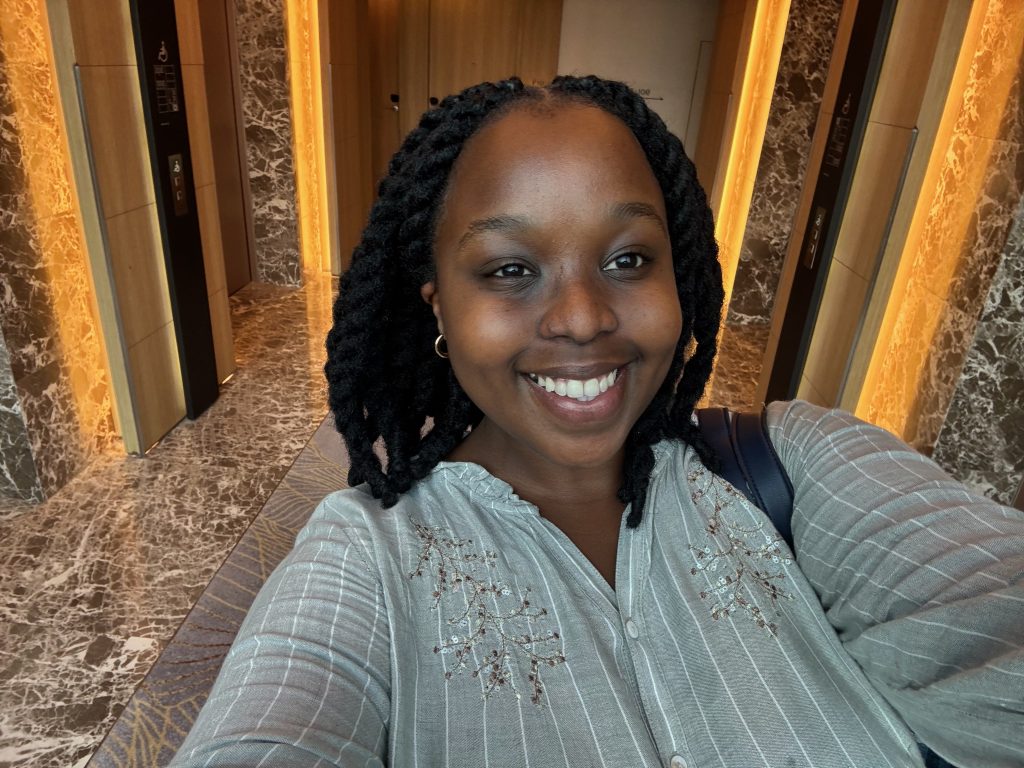
Claire Baine is a Ugandan laboratory technologist specialising in infectious diseases and vaccine immunology, currently working in the Immunomodulation and Vaccines (I‑Vac) Group at the MRC/UVRI & LSHTM Uganda Research Unit. Her journey in immunology began as a volunteer at national reference and research laboratories, working on HIV and COVID‑19 diagnostics and monitoring at Central Public Health Laboratories and the UVRI HIV Reference Laboratory, which exposed Claire to high‑throughput virology and quality‑assured testing systems. This experience led her to the Department of Immunology at UVRI, where she transitioned fully into vaccine research, supporting pre‑clinical vaccine studies, coordinating an inactivated COVID‑19 vaccine pilot, and performing detailed immunological assays such as ELISA, flow cytometry, ELISpot, and pseudo virus neutralisation. The varied projects at these different labs shaped Claire’s growth towards becoming an independent vaccine immunology researcher. Her goal is to participate in studies or research that bridges real-world vaccine effectiveness with different institutions involved in vaccine production.
Read about Claire’s Experience at the Global Young Scientists Summit (GYSS) 2026
We would love to hear more about your ongoing research. What projects are you currently working on, and how do they impact the field?
Currently, my main research is within the Vaccines for Vulnerable People (VAnguard) project in the I‑Vac group, which explores how structural, social, and biological factors combine to influence vaccine impact in communities in Kenya and Uganda. My role focuses on generating immune and metabolic profiles of participants, including processing blood to obtain PBMCs and plasma, stool processing for microbiome‑related work, and running multiplex viral serology (Luminex‑200), flow cytometry, and ELISA‑based assays. By linking these detailed biological measurements to real‑world contexts, our work aims to define biological proxy markers for vaccine efficacy and impact, helping to identify populations that may need tailored vaccination strategies or additional support. In parallel, I contribute to exploratory studies using stored samples from the POPVAC trials to understand environmental and biological drivers of vaccine responses in rural versus urban Ugandan settings, complementing my previous COVID‑19 Immunoprofiling work on durability and quality of antibody and T‑cell responses after different vaccines. Collectively, these projects strengthen the evidence base for context‑appropriate vaccine policy in sub‑Saharan Africa by connecting laboratory immunology with public‑health decision‑making in vulnerable populations.
Please tell us about your work in vaccine development and intervention strategies.
My work in vaccine development and intervention strategies has focused on generating and applying immunological evidence to inform how vaccines are designed, evaluated, and implemented in real-world settings. In earlier roles at the Uganda Virus Research Institute, I have contributed to research aimed at understanding the quality, durability, and breadth of immune responses elicited by different vaccine platforms, particularly for infectious diseases of public-health importance in sub-Saharan Africa. I contributed to multiple COVID-19 vaccine evaluation studies, generating antibody and T-cell response data for adenoviral vector, mRNA, and inactivated vaccines. These studies provided critical insights into immune durability, booster responses, and the influence of prior infection, evidence that directly informed local vaccination strategies and policy discussions.
More recently, my work has increasingly emphasised intervention strategies that go beyond vaccine composition alone. By integrating immunological data with contextual factors such as baseline immune status, co-infections, nutrition, and environmental exposures, I contribute to research aimed at identifying populations that may require modified vaccination schedules, booster timing, or complementary public-health interventions. Collectively, my work supports a shift from one-size-fits-all vaccination approaches toward more context-appropriate, evidence-based strategies that maximise vaccine impact in vulnerable populations.
What inspired you to choose immunology as your focus within the field of science? Has this evolved over time?
My initial interest during my undergraduate training was in molecular biology. However, this began to evolve when I undertook an internship at the Uganda Virus Research Institute, where my exposure to immunology and infectious disease research sparked a deeper curiosity about the immune system and its role in protecting health. I became particularly interested in how vaccines work to prevent disease, how immune responses can be measured, and how vaccine efficacy can be evaluated and optimised in real-world settings to improve the management of infectious diseases.
Over time, this interest has developed into a more focused passion for immunology and vaccinology, driven by the recognition that understanding immune mechanisms is central to addressing both existing and emerging health challenges. Working alongside supportive supervisors and mentors has played a significant role in this evolution. Their guidance has not only strengthened my technical and analytical skills but also encouraged me to pursue opportunities that have broadened my understanding of vaccine-induced immunity and translational research. These experiences have reinforced my commitment to immunology as a field with immense potential to improve population health, particularly in settings disproportionately affected by infectious diseases.
It’s International Women’s Day on the 8th of March. As a woman in STEM, what do you think still needs to be highlighted as an aim for Women’s Day?
As a woman in STEM, I think World Women’s Day should continue to highlight the importance of recognising and celebrating small moments, small wins, and the lessons learned along the way. We live in a fast-paced society that places constant pressure on people, especially women, to always be doing more, moving faster, and achieving the next milestone. While ambition and growth are important, it is equally important to pause and acknowledge progress, no matter how small. These moments remind us why we started and help sustain us through challenging periods. For those just starting out in the field, I would emphasise the value of seeking out and engaging with people who are in positions you aspire to reach. Ask questions, learn from their journeys, and be open to guidance, because, from my experience so far, there is almost always someone willing to share their story and support others. Most importantly, be confident in the knowledge and skills you have, and use them to positively impact those around you. Do not be afraid to learn or to try something new; growth comes from taking the first step, making mistakes, and continuously improving.
What specifically stood out about Immunopaedia that made you want to become an ambassador, and how has your experience as an ambassador affected you?
I was first introduced to Immunopaedia by a work colleague who was once an ambassador. On doing more reading about Immunopaedia, what stood out to me was the commitment to making immunology accessible and to showcasing diverse career paths within the field. The idea of using the platform not only to share my own work, but also to encourage and guide students and early-career scientists trying to enter immunology, strongly resonated with me and motivated me to apply to become an ambassador. My experience as an ambassador has been very enriching. It has pushed me to actively engage with the broader immunology community by reading and learning from the profiles of researchers across different sub-disciplines and career stages. This exposure has broadened my perspective on the field and highlighted the many ways immunology can be applied in research, clinical practice, and industry. Additionally, the role has strengthened my science communication skills and reinforced the importance of mentorship and representation in supporting the next generation of immunologists.
Can you share a moment of unexpected joy or surprise in your scientific career over the past three years that has stayed with you?
One moment of unexpected joy was being selected as a mentee in the Early Career Mentorship Programme for Women Working in Vaccinology under the U.S. National Academies of Sciences, Engineering, and Medicine (NASEM). This opportunity allowed me to connect with exceptional mentors (Dr. Caryn Fenner and Mahlet Woldemariam) and fellow mentees who have provided, and continue to provide invaluable guidance, encouragement, and perspective. Under the NASEM leadership of Daniel Placht and Sofia Bowman, the programme created a supportive and empowering space to openly discuss not only scientific growth and career development, but also how to navigate life as a woman in science alongside other personal and professional commitments. The sense of community, generosity, and shared experience was both deeply affirming, and it has stayed with me as a reminder of the power of mentorship and solidarity in shaping scientific careers.
Claire Baine’s most recent publications:
Timothy Etyang, Ludoviko Zirimenya, Maureen Njue, Robinah Nalwanga, Flavia Zalwango, Kelvin Mokaya Abuga, Henry K Karanja, Noni Mumba, Esther. A. Owino, Winnie Eoju, Christine Kukundakwe, Denis Nsubuga, Claire Baine, Bridgious Walusimbi, Gyaviira Nkurunungi, Agnes Natukunda, Monica Chibita, David Kaawa Mafigiri, Dorcas Kamuya, Sarah Atkinson, Primus Chi, Emily L Webb, Caroline L. Trotter, Pontiano Kaleebu, Alison M Elliott, NIHR VAnguard group. 2024. VAnguard Community Study: Exploring Interrelationships Between Structural, Social, and Biological Determinants of Vaccine Impact in Kenya and Uganda. NIHR Open Research. https://doi.org/10.3310/nihropenres.13925.1
Jennifer Serwanga, Gerald Kevin Oluka, Claire Baine, Violet Ankunda, Jackson Sembera, Laban Kato, Joseph Ssebwana Katende, Geoffrey Odoch, Betty Oliver Auma, Ben Gombe; COVID-19 Immunoprofiling Team; Monica Musenero, Pontiano Kaleebu.2024. Persistent and robust antibody responses to ChAdOx1-S Oxford-AstraZeneca (ChAdOx1-S, Covishield) SARS-CoV-2 vaccine observed in Ugandans across varied baseline immune profiles. https://journals.plos.org/plosone/article?id=10.1371/journal.pone.0303113
Serwanga Jennifer, Kato Laban, Oluka Gerald Kevin, Ankunda Violet, Sembera Jackson, Claire Baine, Kitabye Isaac, Namuyanja Angela, Opio Solomon, Katende Joseph Ssebwana, Ejou Peter, The COVID-19 Immunoprofiling Team, Kaleebu Pontiano. 2024. The Single-Dose Janssen Ad26.COV2.S COVID-19 Vaccine Elicited Robust and Persistent Anti-Spike IgG Antibody Responses in A 12-Month Ugandan Cohort. Frontiers in Immunology. https://www.frontiersin.org/journals/immunology/articles/10.3389/fimmu.2024.1384668
