
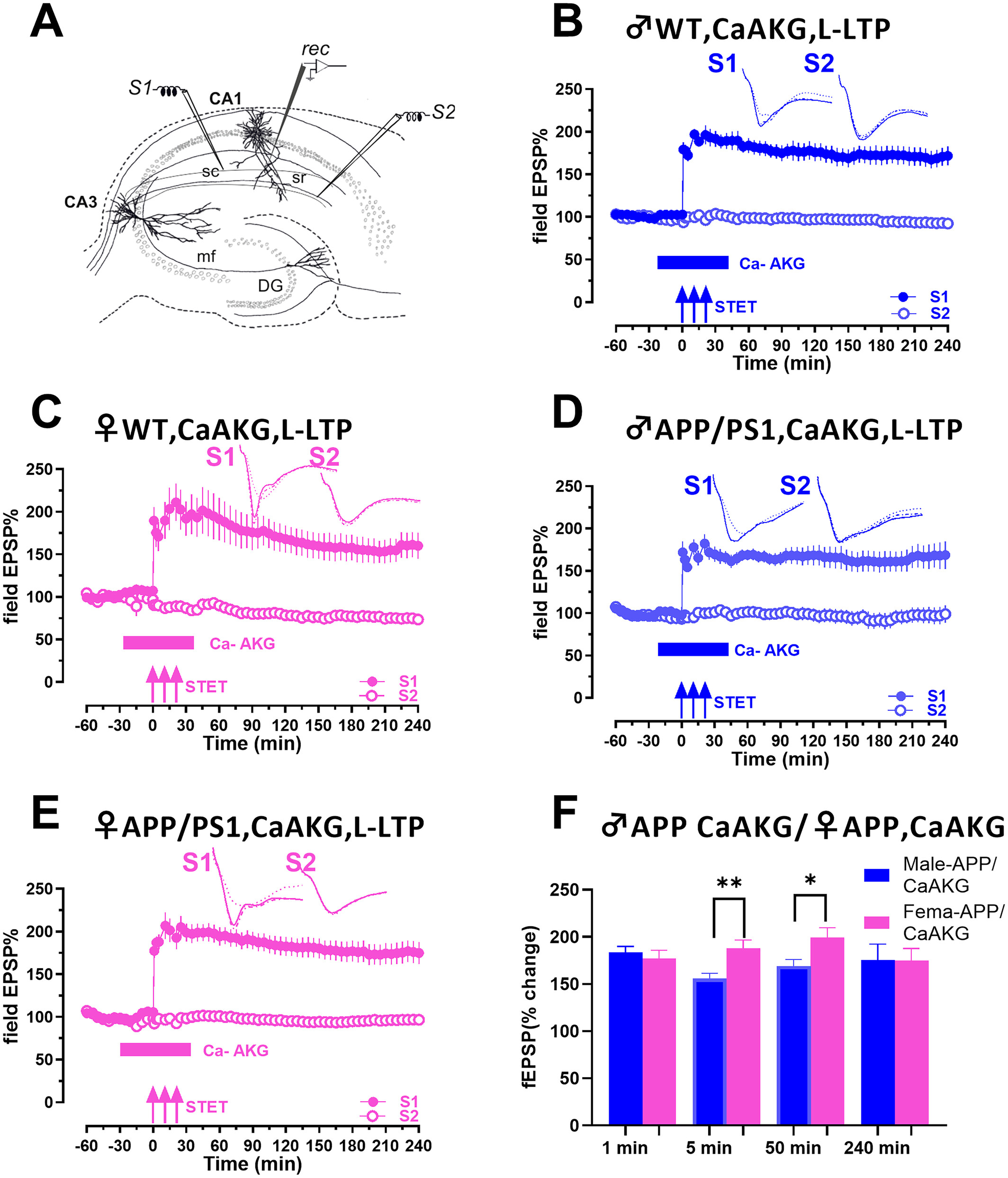
Researchers find that calcium alpha-ketoglutarate restores key brain functions disrupted by Alzheimer’s in preclinical models (Figure 1).
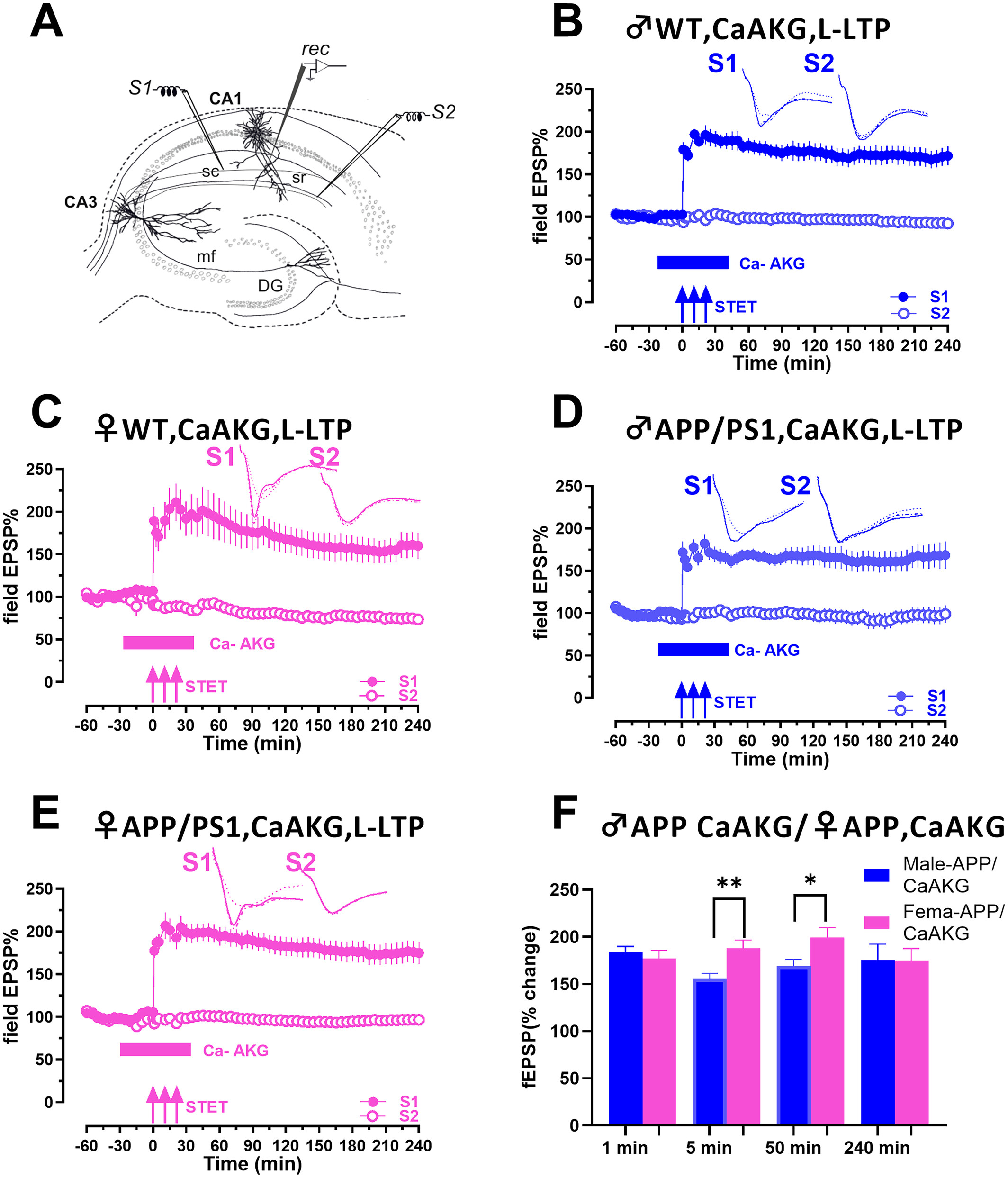
Figure 1: CaAKG ameliorates impaired LTP in APP/PS1 mice with a more profound effect in APP/PS1 females compared to males. (A) Schematic representation of a transverse hippocampal slice with electrodes located in the CA1 area of hippocampus. Recording electrode represented as ‘rec’ is located in CA1 apical dendrites, flanked by two stimulating electrodes S1 and S2 placed in the stratum radiatum (sr) layer to stimulate two independent synaptic inputs to the same neuronal population in the Schaffer collateral (sc) synapses of hippocampus. (B) STET in S1 in presence of CaAKG resulted in a significant potentiation that was maintained for 4 h in male WT mice. CaAKG was bath applied for 60, 30 min before and 30 min after STET. The STET in S1 (blue filled circles) resulted in a significant potentiation that maintained for 4 h, whereas the control potentials in S2 (blue open circles) remained stable throughout the recording (n = 9). (C) STET in S1 in female WT mice in the presence of CaAKG also resulted in a potentiation that maintained for 4 h. STET in S1 (pink filled circles) resulted in a long-lasting LTP for 4 h, whereas the control input S2 (pink open circles) remained stable throughout the time course of recording (n = 5). (D) When STET was delivered to S1 (blue filled circles) in male APP/PS1 mice in presence of CaAKG, it resulted in a long lasting LTP. (n = 8). (E) STET in S1 (pink filled circles) in presence of CaAKG in female APP/PS1 mice also resulted in a long lasting LTP that persisted for 4 h (n = 8). (F) Bar graphs shows comparison of fEPSP values of S1 from male APP/PS1 and female APP/PS1 treated with CaAKG (D, E) at 1, 5, 50-, and 240-min post STET. Blue bars represent the values from male APP/PS1 and pink bars represents value from female APP/PS1 mice. Control stimulation of S2 in B, C, D and E showed stable potentials for the recorded time period (blue and pink open circles). Three solid arrows represent the time of induction of late-LTP by STET. Solid horizontal bars represent the time period of application of CaAKG. Error bars in all graphs indicate ± SEM.
- Restored long-term potentiation (LTP), a key process required for memory formation
- Repaired weakened signalling between neurons
- Recovered associative memory, one of the earliest cognitive functions lost in Alzheimer’s
- Activated L-type calcium channels and calcium-permeable AMPA receptors, increasing neuronal flexibility
- Avoided reliance on NMDA receptors, which are often dysfunctional due to amyloid pathology
- Restored synaptic tagging and capture, a process that allows the brain to link events and form complex, associative memories
